
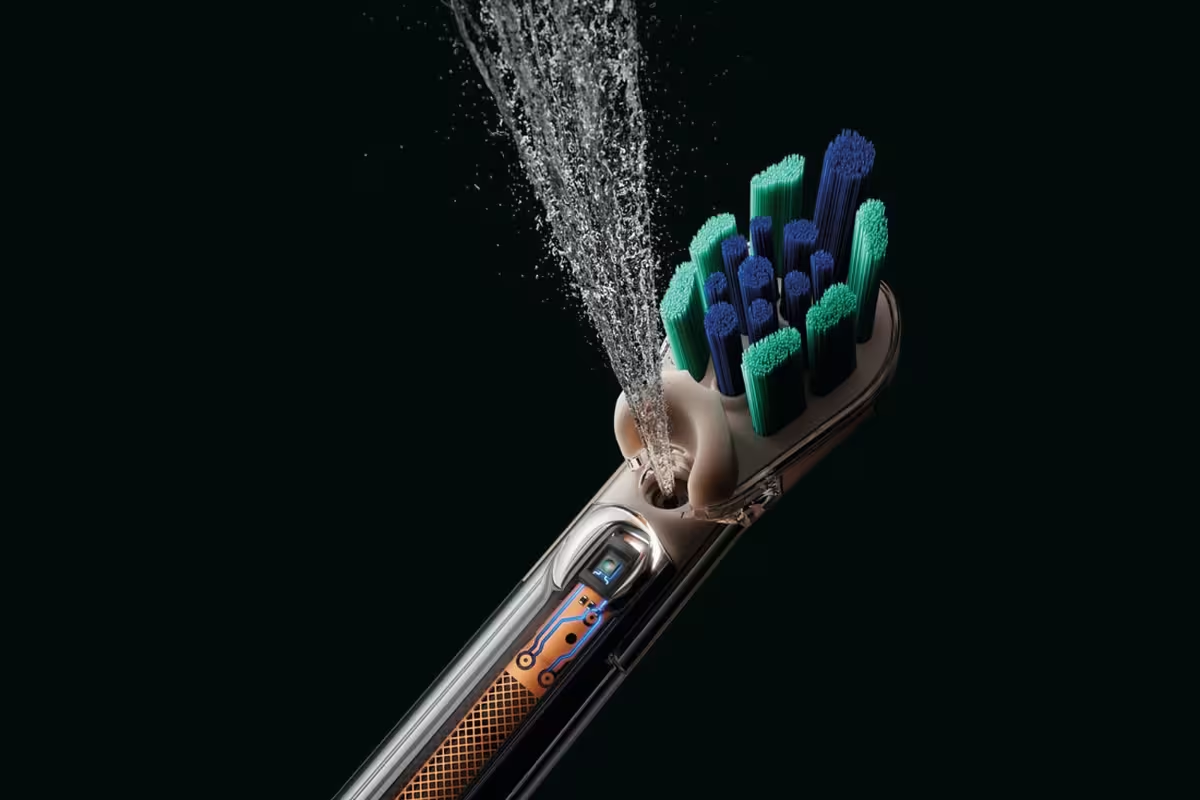
Dyson's first toothbrush uses a macro camera and machine learning to find the gaps between your teeth, then fires a precision jet of mouthrinse to clean them in real time.
Most people know they should floss. Very few actually do it. Dyson's answer isn't a better floss. It's a toothbrush that does the flossing for you.
On September 1, 2026, James Dyson unveiled the Dyson CameraJet in Paris. It's a sonic toothbrush with a built-in camera that spots the gaps between your teeth and blasts them with mouthrinse while you brush. Dyson says it took six years of research, development, and engineering to build.
It combines three steps into one: brushing, flossing, and rinsing.
The numbers on oral care habits aren't great. Dyson cites research showing 9 in 10 people don't floss as often as they should. The average person brushes for just 45 seconds, well short of the recommended two minutes.
What gets missed most is the space between teeth. That's where plaque first forms and then hardens. Over time, it can lead to bad breath, tartar, gum irritation, and tooth decay.
The stakes go beyond your smile. The World Health Organization's 2025 Global Oral Health Status Report estimates nearly 3.7 billion people worldwide are affected by oral diseases. Poor oral health is also increasingly linked to wider conditions, including heart disease and Alzheimer's disease.
The core of the CameraJet is a 100k pixel macro lens camera paired with Dyson's machine learning system, called Gap Optical Targeting.
The camera scans 28 live images per second to identify, track, and predict the gaps between your teeth. Within 100 milliseconds of spotting a gap, it fires a burst of mouthrinse exactly where it's needed.
The system runs on 16 million lines of code and was trained on 470,000 dental images collected during development. Dyson says it's the only toothbrush with a camera designed to precision-floss while you brush.
Traditional water flossers typically use a "needle-type" jet, a narrow, piercing stream. In Dyson's testing, that style of jet punched a hole through plaque but didn't clear it away.
Dyson went a different direction with a broad, cone-shaped spray. The wider coverage sweeps plaque away in one pass and runs at a lower pressure, which Dyson says is gentler on gums and enamel.
To test this without running a clinical trial for every design change, Dyson built its own proxy plaque through a five-year collaboration with the National University of Singapore's Faculty of Dentistry.
The CameraJet holds 12.5ml of mouthrinse, the amount Dyson says is needed to clean all the gaps in one session without flooding your mouth.
Most flossers draw fluid through a straw-style tube, which can suck in air when tilted. Dyson's "anti-gravity" tank uses a diaphragm pump and pressure chamber to deliver consistent jets in any position. That matters most when cleaning the backs of your teeth, where the brush is often held sideways.
A docking station refills the tank in three seconds at the push of a button and charges the brush between uses. A travel case is also included.
Dyson engineers studied slow-motion footage of leading sonic toothbrushes and found that some bristles can jam against the tooth, especially in hard-to-reach spots. The brush is running, but parts of it aren't cleaning.
Dyson's fix is variable sonic oscillation, which constantly changes the angle of the brushing motion to keep bristles moving. According to external testing cited by Dyson, it removes up to 69% more plaque than leading premium electric toothbrushes in hard-to-reach areas.
The brush head uses two bristle types: firmer inner bristles for surface stains and softer outer bristles for the gumline. Each head has an RFID tag that tracks how many cleans it has done and alerts you when it's time for a replacement. A sensitive brush head option is also available.
Dyson also developed its own toothpaste and mouthrinse to pair with the device. The toothpaste is non-foaming and made without SLS, so foam doesn't block the camera's view. The mouthrinse is low-foaming and built for the jet.
Both contain sodium fluoride to strengthen enamel, plus phosphates and xylitol to target the bacteria behind plaque and tartar. They come in Ginger Mint and Spearmint, with a Peppermint Sensitive toothpaste for sensitive teeth.
The CameraJet connects over Wi-Fi and Bluetooth to the MyDyson app. The camera doubles as a live-view endoscope, letting you see inside your own mouth on your phone.
The app also offers guided cleaning, coverage mapping, and personalized feedback on where you're missing spots. Users can choose between auto-detect and manual jetting, and adjust brushing intensity.
On privacy, Dyson says the camera is only active during live viewing or auto-jetting. No images are recorded or stored on the device or in the cloud.
The Dyson Dental System launched September 1, 2026, on dyson.com, in Dyson Demo Stores, and at select retailers. It includes the CameraJet toothbrush, charging dock, travel case, Dyson Toothpaste, and Dyson Mouthrinse.

.png)


.png)

_converted.avif)