


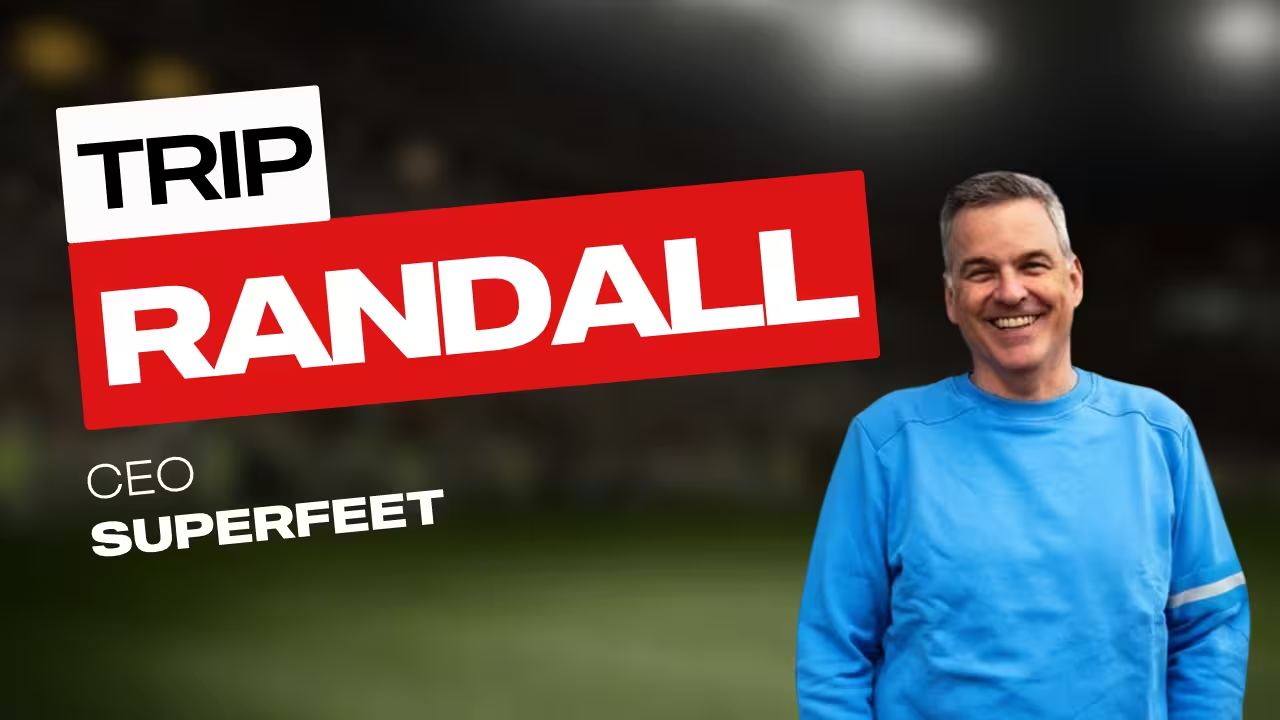
Trip Randall spent 24 years inside Nike during what he calls its golden years, then walked into the top job at a 49-year-old insole company with a goal that sounds almost absurd on paper: get Superfeet into every shoe on the planet. He means it literally. On this episode of the Playbook HQ Podcast, the Superfeet CEO breaks down why the insole, not the shoe, is where performance and pain relief actually start, how a 3D-scanned, left-and-right-specific insole is changing the personalization game, and why the two decades he spent learning to obsess over the consumer at Nike now shape everything Superfeet builds.
Randall's starting point isn't the shoe. It's the foot, and everything underneath it. "Everything really begins at the foot," he says. "It is the foundation, it's your connection to the earth." For most people, a shoe sits between that foot and the ground, and Superfeet's core belief is that very few shoes actually supply the foundation a foot needs to perform at its best.
The case isn't just anecdotal. Randall points to a real kinetic chain: a lack of underfoot support can show up as foot pain, then ankle pain, then knee pain, then work its way all the way up into the back. On the performance side, the same support is framed as an edge rather than a fix — better energy transfer on a cut, getting to a ball faster, the kind of marginal gain that matters when margins are thin. "No four of those feet are the same," Randall says of the people on a single podcast call, and that variability is the whole opportunity: deliver each foot the support that matches how it moves and what it's being asked to do.
Superfeet's audience skews toward sports performance, but Randall is quick to widen the lens. The brand's internal shorthand is to call every end consumer "the athlete," no matter how they're engaging the world that day. That spans the competitive athlete on the field, the person in the city chasing 20,000 steps between an apartment and a gym stop, and what Randall calls the industrial athlete — the worker on their feet all day on concrete, on a construction site, on a production line, or behind a counter as a barista.
Each of those use cases carries different underfoot needs, and the product line splits accordingly: some products built specifically for the demands of one activity, others built broader for the person who just wants solid, all-day support without needing to diagnose their own gait first. "We feel like we give each of those each of those consumer groups something to chew on," Randall says, "to help them get the benefit of Superfeet."
Randall's favorite recent build is ME3D, Superfeet's personalized insole platform, made specifically for an individual's left and right foot rather than the matched pair sold off a shelf. Getting scanned works two ways: through a mobile scanning option at superfeet.com (iPhone only, for now) that maps a user's arch profile, or in person at a Fleet Feet running shop. The product was relaunched this year with new materials and a new build process, and it's 3D-printed in Superfeet's print lab in Washington. "Things are just getting more customized and personalized for everybody," Randall says, and ME3D is Superfeet's answer for the share of customers who want to go a level past an off-the-shelf insole, where the left and right are identical.
That personalization push now sits alongside a broader sport-specific expansion. Superfeet rolled out its Cleat and Sport collections earlier this year, led by the Cleat Playmaker Elite ($94.99) — built for soccer, football, baseball, lacrosse and other grass and turf sports, with a Carbitex® carbon fiber plate that testing showed helped athletes accelerate up to half a yard faster. The Sport Collection (Sport Ultralight, Sport Support, Sport Cushion, $44.99–$64.99) was built to move with athletes across tennis, pickleball, golf and the gym floor. In October, Superfeet followed with the Court Playmaker Elite and Court Playmaker ($44.99–$94.99), extending the same carbon-fiber-plate approach to basketball and volleyball; in athlete testing, Court Playmaker Elite wearers measured an average of 12 inches faster on quickness tests, with 89% reporting improved stability and grip. "We're bringing focus to the court with insoles fine tuned specifically for movement and performance," said Superfeet VP of Product and Innovation Matt Gooch of the launch.
Asked for a story that sticks with him, Randall goes straight to the most recent one. A friend, a strong golfer who likes to walk the course — five or six miles of up and down a day — was dealing with plantar fasciitis and asked Randall for help. Randall gave him a Run Pain Relief insole to try in his golf shoes.
Four or five days later, the friend texted back: "...you're a witch," followed by a witch emoji, and he was out walking the course again. For Randall, the value of the story isn't the magic — it's how fast it worked and how often that reaction repeats. "We get that quite a bit," he says. "We hear from people all the time how this product helps them and changes the way they think about their day."
Before Superfeet, there was Nike — 24 years of it, which Randall calls a dream job from day one. He and his wife, Darcy, moved to Oregon with no kids and figured they'd stay a couple of years; three daughters and roughly 13 roles later, they never left. A college runner himself, Randall remembers his brother running in early Tiger (Onitsuka Tiger, the brand that would become Asics, and separately helped spawn what became Nike) back in the '70s, which makes his own run at the company feel, in his words, like a dream realized.
He's candid that he was there during Nike's golden years — the best innovation in the category, the best athletes in the world, and resources he didn't fully appreciate until he left for a smaller company. But the single lesson that followed him to Superfeet is a relentless focus on the consumer: starting every product conversation with what a consumer needs, whether they've already said so or haven't realized it yet. "That was really just, you know, part of how your blood flowed at that place," he says, and it's shaped Superfeet's performance push since he arrived roughly three and a half years ago — starting with a sharp focus on running, then expanding into other sports as the team spotted unmet consumer needs.
Randall's family comes first when he talks about motivation — his wife and three daughters, who he says put up with a demanding work schedule because, as he puts it, he's doing it for them. But asked about the people who shaped his approach, he goes straight to Nike.
Gary DeStefano, a former Nike president and one of Randall's first bosses, taught him to be bold — "go big or go home" — but paired it with a personal touch: DeStefano knew everyone on campus regardless of role, and made people feel important. Elliot Hill, Nike's current CEO, gets credited the same way — someone who listens, has a sense of humor, and can still make a hard call when one's needed. And Christiana She, who Randall worked alongside in Nike's digital and retail business, is remembered for a different skill entirely: the ability to build a consumer strategy from her consulting background and bring people's feedback into it in real time. Randall calls her "the varsity." "You kind of take bits and pieces from those folks," he says, "and you want to believe you're putting your own stamp on it along the way."
Randall's advice for anyone stepping into a new role or a first leadership seat starts before the role itself: make sure it has what a mentor once called the "sweaty palms factor." If a new job doesn't make you a little nervous, he argues, it may not be pushing you forward. He points to his own jump from Nike into private equity at Denon as a moment that qualified.
Once you're in the seat, his second piece of advice is about pacing. He compares joining a new organization to a spacecraft reentering the atmosphere: come in too steep and aggressive — acting like you already know it all — and you burn up on reentry. Come in too shallow, never trying to make a mark or get heard, and you skip off the atmosphere and get sent back into space, maybe for good. The answer is finding the right angle: listen hard, read the cues, and look for the right moments to be heard, without trying to force a promotion before you've actually done the work.
Weights, twice a week-ish — Maintaining strength and flexibility specifically to protect his golf swing and keep his distance from slipping as he ages.
Treadmill or Peloton — Regular cardio to keep his heart rate in check between a packed work schedule.
Hydration + Element electrolyte packets — "We're an Element family," he says; the packets are always somewhere in his bag because he cramps up easily.
Golf — His measuring stick for staying fit; he wants to keep hitting the ball well and protect his handicap as he gets older.
Consistency itself — Randall is candid that staying regular with the stack, not any single product in it, is his biggest ongoing challenge.
Trip Randall didn't rebuild Superfeet by chasing novelty. He rebuilt it by applying the one lesson he says he couldn't help but absorb at Nike — start with the consumer, every time — to a product category most people still don't think hard about. The insole industry's real barrier isn't competition, it's awareness: a lot of people simply don't understand what an insole does for them, which makes the sport-by-sport expansion into Cleat, Court and Sport collections less a marketing push and more an education campaign with product behind it.
ME3D is the clearest signal of where Randall wants this to go: not a single universal fix, but a product built around the fact that no two feet, and no two athletes, move the same way. Ten years from now, he says, he wants Superfeet to be the company people turn to by word of mouth, because the benefit was real enough that they told two friends, who told two friends. For a brand entering its 50th year, that's a patient, consumer-first bet — and it's the same bet Randall watched work for two decades, from the inside, at Nike.
Learn more or shop the new collections at superfeet.com.


