
How NFL teams are using BFR technology to win the injury prevention arms race.
Injury prevention has quietly become one of the most important competitive advantages in the NFL. The final four Super Bowl contenders this past season shared one notable trait: the lowest injury rates in the league. That's not a coincidence — and teams like the Atlanta Falcons are building their entire in-season training philosophy around it.
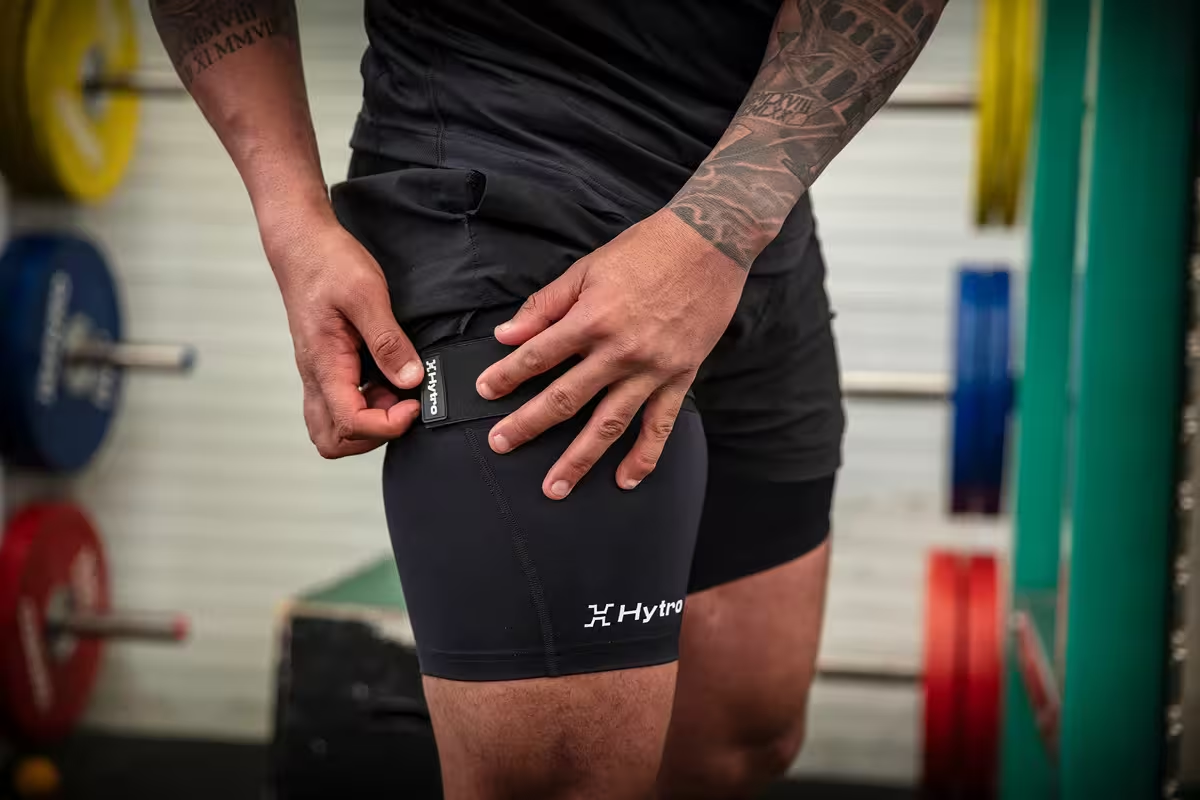
Blood Flow Restriction — BFR — involves applying controlled pressure to the limbs during exercise to restrict venous blood flow, forcing the muscle to work harder at significantly lower loads. The Falcons have integrated Hytro BFR Shorts into their weekly protocols, using them to drive muscle growth, enhance endurance, and accelerate recovery without piling additional stress onto players already grinding through a 17-game season. As the team's performance staff puts it: "We're looking for cell swelling and metabolic stimulus without adding extra load."
The 24 hours after a game are about one thing: getting players back to baseline. The Falcons use that window to restore range of motion and achieve what their staff describes as "long muscle lengths" — returning the body to homeostasis before the week's practice load begins. BFR fits that goal precisely. Sessions on the bike follow a 20-seconds-on, 10-seconds-off interval structure at moderate intensity, paired with isometric holds — five seconds on, five seconds off — to stimulate blood flow without taxing an already-depleted system.
In-season strength training has always been a time and load management problem. You want to maintain the training stimulus. You don't want to break players down. BFR compresses that tradeoff. "In-season, you don't really have a lot of time to train guys, so you have to be efficient with your time," the Falcons' performance staff explains. "Having a product like Hytro gives us the flexibility to train the team holistically rather than focusing on individuals." The portability matters too — sessions can happen on the field, in the weight room, in the locker room, pre-game or post-game.
The Falcons track player readiness daily using load support assessments and vertical jump testing — a simple but reliable neuromuscular readiness marker. Those numbers inform how aggressively the staff pushes training loads as the week builds toward game day. The goal isn't just recovery — it's understanding precisely where each player sits on the readiness curve and programming accordingly.
Player Buy-In
BFR is counterintuitive at first. Players accustomed to heavy loads were initially surprised by how much stimulus they could generate with minimal weight. But the response shifted quickly. "Once they take them off and start moving around, they realize the impact," the team's performance staff noted. That experiential proof point — feeling the effect rather than being told about it — has been central to how BFR earns trust in professional locker rooms.
Hytro is already embedded with the Washington Commanders and Buffalo Bills, both playoff contenders this past season. The pattern is consistent: teams investing in recovery infrastructure are outperforming on availability, and availability is directly tied to winning. "The best ability is availability" — the old Bill Parcells line — has never been more operationally true than in the modern NFL.
BFR isn't new to sports science. But its adoption at the NFL level — integrated into weekly protocols, not just rehab — marks a shift in how elite teams think about the relationship between load management and performance maintenance. The Falcons' approach treats recovery not as a passive process but as a training modality in its own right. That framing is spreading.
The arms race in professional sport has moved from the weight room to the recovery room. Teams that figure out how to keep their best players on the field — not just healthy, but performing at a high level late in the season — are the ones hoisting trophies. BFR is one of the cleaner tools in that toolkit: low risk, portable, and increasingly backed by real-world NFL results. Expect adoption to accelerate. The Falcons and their peers are building the case game by game.

.png)


.png)

_converted.avif)